
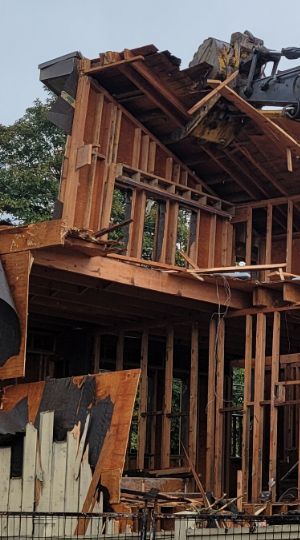
Once multiplexes were allowed on most house lots in Burnaby and New Westminster, a new kind of buyer started knocking on doors: the small builder who wants your lot, not your house. If you're thinking of selling, the useful question isn't whether a builder will pay a premium. It's which of two buyer pools, families or builders, will value your particular property more. Our guide to selling to a builder covers your options. This post is the decision guide: how each buyer does the math, the signs that point one way or the other, and how to let them compete.
Two buyers, two ways of pricing the same property
A family buyer prices your home by comparing it with similar homes nearby. The kitchen, the roof, the layout and the school catchment all matter. Their budget is set by what a lender will approve.
A builder prices your lot backwards. They start with what the finished homes could sell for, then subtract everything it takes to get there: design, permits, City charges, servicing, construction, financing, contingency and their profit. What's left is what the land is worth to them. Your renovated kitchen adds almost nothing to that number, because it's going in the bin.
That's why the same street can hold a lot worth a premium to a builder and a lot worth nothing extra. Two things decide most of it: how many homes the lot allows, and how expensive those homes are to deliver.
Step 1: how many homes your lot allows
A builder's top line is the home count. In Burnaby, every former single-family lot was rezoned to the R1 district in June 2024, and the City says R1 lots can hold 3 to 6 homes depending on lot area and distance to a frequent bus stop. Lots within 400 m of a stop served at least every 15 minutes on average (7 a.m. to 7 p.m. on weekdays, 10 a.m. to 6 p.m. on weekends) sit in a Frequent Transit Network Area, which is where 6 becomes possible. Suites count toward the total. Our post on 4 homes or 6 in Burnaby walks through the test.
In New Westminster, the Infill Housing Program zoned lots as RGO-A (up to 4 homes) or RGO-B (up to 6). Queensborough house lots are not included for now. See RGO-A or RGO-B for how to tell which you have.
A 6-home lot gives a builder two more homes to sell against many of the same fixed costs. That's often where a builder can outbid a family. A lot limited to 3 homes usually isn't.
Step 2: what it costs to deliver those homes
Every cost a builder carries comes off what they can pay you. Some examples from published figures:
| Cost | Figure | Source |
|---|---|---|
| Burnaby DCC + ACC, medium density (most multiplexes) | $56,297 per home, suites included | City of Burnaby |
| Same charges on a 6-home ground-oriented design | 6 × $56,297 = $337,782, before credit for the house removed | City of Burnaby rates |
| Duplex or multiplex construction | $275 to $500+ per sq ft, excluding land | By Design Construction |
| BC Hydro service upgrade | $2,000 to $120,000, higher if a transformer is needed | By Design Construction |
| Contingency | 10% to 15% on top of the quote | By Design Construction |
Burnaby charges on a net new basis, so the existing house is credited. In New Westminster, the City says its pipes were designed for up to 3 homes per lot, and projects with more than 3 homes that go ahead before the City upgrades the street must pay for the upgrades themselves. The City says that cost will be prohibitive for some small projects. A New West lot on a street that needs a new water main may be worth less to a builder than its RGO-B zoning suggests. Our post on water and sewer upgrades explains how that works.
Signs a builder will likely pay more
- Your lot allows 6 homes (Burnaby Frequent Transit Network Area, or New West RGO-B), or at least 4.
- It's wide and rectangular, fairly flat, with a lane at the back.
- No large trees sit where a rear building would go.
- The house is dated or needs major work, so a family buyer would discount it anyway.
- Nothing on title (easements, covenants, rights-of-way) cuts into the buildable area.
- In New West, the street has servicing capacity, or the City has already upgraded it.
Signs a family will likely pay more
- The house is updated and in good condition. A builder won't pay for that work; a family will.
- The lot is narrow, irregular, steep or limited to 3 homes.
- Protected trees, heritage controls (such as Queen's Park in New West) or title issues would cost a builder a home or months of time.
- The street needs costly servicing upgrades before a multiplex could proceed.
- The school catchment or location is what buyers pay for.
Price isn't the only number: compare the terms
Two offers at the same price can be very different deals. Builder offers often come with longer conditions, because the builder needs to confirm the survey, trees, servicing and design before committing. Some want a long completion so they can line up permits. Family buyers usually need financing and an inspection, with shorter conditions. When you compare offers, line up:
- Net to you after commission and any credits you agree to.
- Certainty: how many conditions, how long they run, and how big the deposit is.
- Timing: whether the completion date works for your next move.
- What happens if the deal collapses: a builder who walks after 30 days of due diligence has cost you 30 days on the market.
A note on tax
The Canada Revenue Agency says the gain on a home that was solely your principal residence for every year you owned it is generally exempt, and you must still report the sale on your return to claim it. Selling a long-held home as-is to a builder usually stays in that territory. Building and selling the new homes yourself, or partnering on a project, is a different situation. Talk to your accountant before you choose a path.
The practical takeaway: let both buyers compete
You don't have to guess. If your lot shows several of the builder signs above, market it to builders and families at the same time. Describe the lot facts builders need (zone, home count, lot size, lane, trees, transit status) alongside the usual photos and features. Then the price is set by competition, not by the first builder who knocked.
Start by checking your address on the lot map. If you want a read on both numbers, what a family would likely pay and what the lot is worth to a builder, request a free lot review.
Sources
- City of Burnaby, Zoning Bylaw Rewrite (R1 SSMUH District, 3 to 6 homes, Frequent Transit Network Area definition), checked November 1, 2026
- City of Burnaby, Development Funding Program (DCC and ACC rates), checked November 1, 2026
- City of Burnaby, DCC and ACC for SSMUH developments (density categories, net new unit credit)
- City of New Westminster, Infill Housing Program (RGO-A and RGO-B, servicing upgrades, Queensborough), checked November 1, 2026
- Canada Revenue Agency, Principal residence and other real estate, checked November 1, 2026
- Construction, BC Hydro and contingency ranges: By Design Construction, 2026 project estimates, as published on our Burnaby multiplex guide. Not quotes.
General information, not legal, tax or financial advice. Rules change; confirm anything for your property with the City and qualified professionals.