
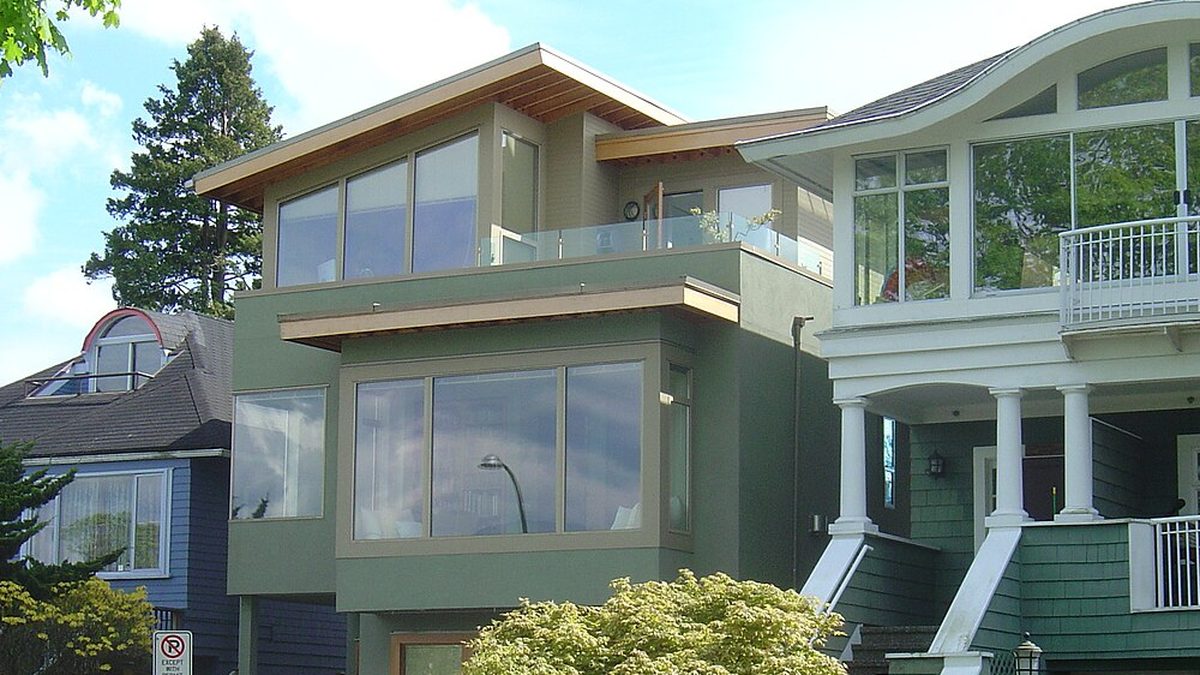
Photo: pnwra, CC BY 2.0, via Wikimedia Commons. Cropped.

Most owners in Burnaby and New Westminster have never paid tax on the sale of a home, because a principal residence is usually exempt. Build a multiplex and sell the new homes, and that can change. The profit may be taxed as business income, GST may apply to each new unit, and short holding periods bring in two separate flipping rules. Here's how the rules fit together, so you can ask your accountant the right questions before you design anything. General information, not tax advice.
Three ways the same profit can be taxed
| Treatment | What it means | When it usually applies |
|---|---|---|
| Principal residence exemption | The gain is generally not taxed, but you must still report the sale. | Selling the home you lived in, for every year you owned it. |
| Capital gain | Half the gain is taxable. The federal government cancelled the proposed increase to that rate in March 2025. | Selling property you held as an investment, such as a rental. |
| Business income | The whole profit is taxable, and no principal residence exemption. | Building or buying to sell at a profit, or selling within 365 days. |
On the same dollar of profit, you could owe nothing or tax on all of it.
Selling as-is: usually the simplest tax picture
If you sell your house to a builder without building anything, you're usually in the first row. The Canada Revenue Agency (CRA) says you can designate one home per family as your principal residence for each year, and the land that counts is generally limited to half a hectare. Since 2016 the exemption is only allowed if you report the sale and the designation on Schedule 3 of your return, and the CRA says a penalty may apply to a late designation.
That simplicity is one reason our selling to a builder page lists selling as-is as the lowest-risk option.
Building to sell: why the exemption can disappear
The CRA's principal residence folio is direct about it: if your gain is business income, it cannot be exempt under the principal residence exemption, and "the sale of one house can result in business income." You don't need to be a full-time developer for this to apply.
Whether a profit is business income is a question of fact. The CRA's older interpretation bulletin on an "adventure or concern in the nature of trade" (IT-459, now archived but still useful) describes the kinds of things it looks at:
- Your conduct. Did you deal with the property the way a builder or dealer would? Improving a property to make it more marketable, then listing it, points toward trading.
- Your intention. What did you plan when you started? A secondary intention to sell can count, and intention can change before the sale.
The bulletin also says a single, one-off transaction can still be a trading transaction. Building three or four new homes and selling them looks a lot like what a builder does. So the profit may not get principal residence treatment even though you lived on the lot for decades.
The two flipping rules (different rules, different governments)
Federal, 365 days. For sales on or after January 1, 2023, a gain on a housing unit you owned for less than 365 consecutive days is deemed business income, the principal residence exemption isn't available, and a loss is deemed to be nil. There are exceptions for life events such as a death, a relationship breakdown, serious illness, an eligible relocation or involuntary job loss.
B.C., 730 days. The Province's home flipping tax applies to dispositions on or after January 1, 2025. It is 20% of the net taxable income on a property sold within 365 days, and the rate falls over the next 365 days to zero at 730 days. The Province says it is separate from the federal flipping rule. It has its own exemptions, and we'll cover it on its own in a future post.
Most multiplex projects take longer than either period. As our post on how long a multiplex takes explains, two years from first sketch to move-in is typical. But if you buy a lot to build on, the clock starts on the purchase date, not the build date, so check it.
GST: the tax owners forget
Income tax isn't the only question. In B.C. the federal GST is 5%, and the CRA's rules on new housing can apply to an individual who builds.
- Selling new homes. The CRA's memorandum on residential sales says a builder's sale of a newly built residential complex is generally taxable. If you build homes to sell, you are generally the builder.
- Living in it. There is an exemption where the builder is an individual who uses the complex primarily (more than 50%) as their own residence and hasn't claimed input tax credits on it.
- Renting the units. If you build a multi-unit complex and rent out units, the self-supply rule can treat you as having sold and bought back the whole complex when you first give possession of a unit. You then owe GST on its fair market value, building and land. The same personal-use exclusion applies to an individual who lives in the complex primarily.
In a fourplex where you live in one unit, whether you use the complex "primarily" as your residence is exactly the kind of question to put to an accountant early. Rebates exist, including the new housing rebate and the new residential rental property rebate, but each has conditions. Our post on comparing builder quotes covers GST on construction contracts.
Three common plans, and the questions each raises
| Your plan | Questions for your accountant |
|---|---|
| Sell the house as-is | Was it your principal residence every year? Has the sale been reported with the designation? |
| Build, live in one unit, rent the rest | Does self-supply GST apply? How is the rental part of the property treated when you eventually sell? Which rebates fit? |
| Build and sell every unit | Is the profit business income? Do you need to register for GST? How are the land and your old house's value split? |
If you're thinking of a land-for-homes deal, the tax questions are different again; our builder partnership post touches on them.
Before you start: a short checklist
- Talk to an accountant before you pay for drawings, not after you've sold. The plan decides the tax, and it's hard to change later.
- Write down what you intend to do with each unit (live, rent, sell, give to family) and keep it with your project file.
- Keep every receipt and invoice. Your costs matter under every treatment.
- Note your purchase date and work out when 365 and 730 days fall.
- Ask whether you need to register for GST, and when.
The takeaway
Selling as-is usually keeps the tax simple. Building and selling can earn more before tax, but the profit may be fully taxable as business income and GST may apply to the new homes. Get advice first, then compare the after-tax numbers for each option. If you want to know what your lot can hold before that conversation, request a free lot review.
Sources
- Canada Revenue Agency, Principal residence and other real estate (one home per family per year, half hectare, Schedule 3 and T2091, late designation penalty, 365-day flipping rule and life events), checked November 12, 2026
- Canada Revenue Agency, Income Tax Folio S1-F3-C2, Principal Residence (¶2.6 business income, flipped property from January 1, 2023), checked November 12, 2026
- Canada Revenue Agency, IT-459, Adventure or Concern in the Nature of Trade (archived; conduct, intention, single transactions), checked November 12, 2026
- Office of the Prime Minister, Prime Minister Carney cancels proposed capital gains tax increase, March 21, 2025; Canada Revenue Agency, Update on the administration of the proposed capital gains changes (one-half inclusion rate)
- Province of B.C., BC home flipping tax (from January 1, 2025, 730 days, 20% within 365 days, separate from federal rules), checked November 12, 2026
- Canada Revenue Agency, GST/HST Memorandum 19-2-1, Residential Real Property: Sales (builder sales taxable, personal-residence exemption over 50%, no input tax credits)
- Canada Revenue Agency, GST/HST Memorandum 19-2-3, Residential Real Property: Deemed Supplies (self-supply of multiple-unit complexes at fair market value, individual personal-use exclusion)
- Canada Revenue Agency, RC4052, GST/HST Information for the Home Construction Industry (who is a builder, 5% GST outside HST provinces, rebates)
- Two-year typical span: our multiplex timeline post.
- Photo: pnwra, CC BY 2.0, via Wikimedia Commons.
General information, not legal, tax or financial advice. Rules change; confirm anything for your property with the City and qualified professionals.